Pages

Saturday, 29 June 2013

I got a graphics tablet today. This is how Being & Tim are going to look for abit!

Sorry for the absence, I've been busy working on some philosophy cartoons and some photoshop montages as part of my self-employed jobbings. You can see one of my images at http://www.philosophicalinvestigations.co.uk/ although Peter came up with the joke.

Anyway, I'm going to get practising on my graphics tablet!

becca x

Friday, 1 February 2013

Something else...

Here's a little cartoon I did the other day about my job. More Being & Tim to come at some point, but just  got back from holiday so not had much time recently.... especially cos I went sailing on a tall ship! YARGGH! Becca x

Sunday, 6 January 2013

Happy Epiphany!

Find out more here -----> http://en.wikipedia.org/wiki/Nothing_comes_from_nothing
Haha! Obscure linguistic jokes. To be fair, Y is pretty hard to find jokes for. See this website for more ----> http://webspace.ship.edu/cgboer/langorigins.html
Now this one is my favourite of today's comics. Being doesn't realise that slow and steady really does win the race. Especially when Zeno makes the rules. See more here ----> http://en.wikipedia.org/wiki/Zeno's_paradoxes
So here are the last installments of the Being & Tim advent calendar, just in time for Epiphany and the total end of the festive season. TAKE YOUR CARDS DOWN TODAY OR BAD LUCK WILL FOREVER FOLLOW YOU. Thems the rules folks.

If you've enjoyed the advent calendar I'll be self-publishing a limited edition hand-bound, all colour, BOOK, as well as individual prints, at my etsy shop, which is here:

http://www.etsy.com/shop/beingandtimetc

If a cartoon from the site isn't there but you'd like to buy it then just send me a message and I'll sort it out for you.

Otherwise, thank you very much for following the blog, and I hope to get some more cartoons up here soon!

Becca x

Thursday, 3 January 2013

W is for Windowless Monad

Pre-established harmony

From Wikipedia, the free encyclopedia

Gottfried Leibniz's theory of pre-established harmony (French: harmonie préétablie) is a philosophical
theory about causation under which every "substance" only affects itself, but all the substances 
(both bodies and minds) in the world nevertheless seem to causally interact with each other because
they have been programmed by God in advance to "harmonize" with each other. Leibniz's term for 
these substances was "monads" which he described in a popular work (Monadology §7) as 
"windowless".

An example:An apple falls on Alice's head, apparently causing the experience of pain in her mind.
In fact, the apple does not cause the pain - the pain is caused by some previous state of Alice's mind.
If Alice then seems to shake her hand in anger, it is not actually her mind that causes this, but 
some previous state of her hand.

Leibniz's theory is best known as a solution to the mind-body problem of how mind can interact with
the body. However, Leibniz also rejected the idea of physical bodies affecting each other, and 
explained all physical causation in this way.

Under pre-established harmony, the preprogramming of each mind must be extremely complex, since
 only it itself causes its own thoughts or movements, for as long as it exists. In order to appear to
 interact, each substance's "program" must contain a description of either the entire universe, or of 
how the object is to behave at all times, during all "interactions" which will appear to occur.

It can also be noted that if a mind behaves as a windowless monad, there is no need for any other
 object to exist in order to create that mind's sense perceptions, leading to a solipsistic universe 
consisting only of that mind. Leibniz seems to admit this in his Discourse on Metaphysics section 14.
However, he claims that his Principle of Harmony, according to which God creates the best and
 most harmonious world possible, dictates that the perceptions (internal states) of each monad 
"expresses" the world in its entirety, and the world expressed by the monad actually exists.
 Although Leibniz says that each monad is "windowless," he also claims that it functions as a
 "mirror" of the entire created universe.


(I really had no idea how to describe monads, so had to rely on Wikipedia today!)
Becca 

Wednesday, 2 January 2013

V is for.....!


Hi everyone! Happy New...ton's third law of physics! (as a friend of mine said the other day....)!
I hope your Festive seasons have been going well, look what I found down the back of the sofa.....

yes, it's that old advent calendar that I forgot to open all the windows to! Let's have a look!


V is for....Visual Trickery!

Is it obvious that the shape Tim is holding is an impossible figure? I'm not sure if I drew it affectively enough, but it took awhile to get the hang of it so in the end I just settled with this...

I like the idea that Being is truly disturbed by the shape anyway, it reminds me of the old debate between the Kantian Transcendental Aesthetic on the one hand and the people who say 'ah but we can make a mobius strip therefore we can really conceive of infinity' or 'ah, but we can imagine 4 dimensions so we are not mentally restrained by 3 Dimensional space.....' (I wish I could remember the reference but there's an article I read in my second year that basically does this...anyone know who it is?)

I have to say that I have never, ever, been able to imagine 4 spatial dimensions. If someone would like to enlighten me then I would be very interested to know more, but I still think, that in the same way the impossible figure in this cartoon is, despite appearances, represented in the 2 dimensions of the page, that all the thought experiments that people throw up as attempts to critique the Transcendental Aesthetic do remain constrained within space and time. It's been a long time since I studied Kant, but I do generally think that representation requires certain things just to make sense. (Kant talks about the boat going down the river: we couldn't make sense of that happening without a presupposed notion of causality, of one event following the other, otherwise we'd just have crazy mad hallucinationary sensations) Of course have we then just pre-defined representation as 3-dimensional and causal? I think that's where some of the confusion of these thought experiments comes in, what would it mean to imagine 4 spatial dimensions? What would be the criteria of testing that we had successfully done it? The words stop making sense in the way we want them to I think, which reminds me of the famous Kant quote:

'The light dove, cleaving the air in her free flight, and feeling its resistance, might imagine that its flight would be still easier in empty space' (erm, in the critique somewhere)

Kant's not talking about a semantic issue here but I think the point can be transferred. There comes a point where the lack of empirical facts/criteria of meaning (resistance) makes the concept affectively empty, so thought can no longer proceed clearly. How this manifests in these thought experiments is critics saying 'well Kant is wrong because we just can imagine in 4 dimensions...just try this....[enter thought experiment of choice]' I never knew what they meant when they said that.....
In my head this has parallels with the problematic nature of the relationship between the infamous noumenal realm and the phenomenal realm. (Questions like 'how does the thing in itself actually relate to the appearance?' This is particularly problematic when you think that the Transcendental Self is really supposed to be noumenal, which begs the question - do i have 2 selves?! What does that mean?!) At what point do you decide that the concept has become empty?! Is it when you get to 4 D shapes, or do we then just end up with a sort of consensus view, rather than the sort of truth Kant himself was keen to establish? (At this point I remember reading the Groundwork of the Metaphysics of Morals and my exasperated tutor trying to explain that building one's moral thought on the pre-suppositions of rationality was not the same as building it on consensus. Still there's room for exploration I think....)

I'm sure I'm running some terms together here (as I'm basically just typing off the top of my head) and  with Kant it's important not to do that, especially when it comes to the Pure Concepts of Space and Time.  Someone was good enough to point out how easy it is to run terms together in our discussion of the apriori/aposteriori (See this earlier post) But the reason it's so important to be conceptually precise when it comes to Kant, is I think, that it's very easy to simply say 'oh well that's just beyond our understanding' or 'noumenal' when perhaps the issue needs more interrogation. So despite the fact I once chuckled at the thought experiments I mentioned above, I now have more respect for what these authors were trying to achieve. But not to the point where I actually want to read the whole Critique ;-)

Anyway, I'm sure you lot could put me straight, care to share?

Becca

ps. Oh, and despite the fact I'm running late, I'm going to wait til later in the week for the rest of the alphabet, I just love building the suspense!


Friday, 21 December 2012

T U and the End of the World!


So here are yesterday's and today's advent calendar offerings: T for Thus Spake Zarusthustra and U for Unhiddenness. I know the hermeneutic process of uncovering the un-hiddenness of Being is probably a lot less simple than the image implies, but I thought it'd be nice to let Being have a bit of fun for a change!


As for the Zarashustra quotation in the top cartoon the reference is from p 77-78 of the R.J Hollingdale 1969 translation, published by Penguin in the UK. Even after having done an MA dissertation on Nietzsche I still don't feel comfortable with Thus Spake Zarasthustra as a text. It is by turns philosophically perceptive and (dare I say it!) moving, but also confusing, obscure and downright mental in parts. I may do a week of cartoons based on TSZ, just because I feel it's a text that deserves more recognition: it's very multi-faceted, and you'd be surprised how radically different it is from the popular reading of Super-Nazi-Over-Men that gets thrown around. I also think Being & Tim could have some fun with Zarasthustra's Eagle....!

Lastly, a very quick sketch dedicated to the Mayans and the collective sigh of relief we all breathed at 11.12 today when the world didn't end. The inspiration is the following Kierkegaard quotation, which may or may not be correctly attributed, coming as it does from www.goodreads.com. It certainly sounds like something Soren'd say.

“A fire broke out backstage in a theatre. The clown came out to warn the public; they thought it was a joke and applauded. He repeated it; the acclaim was even greater. I think that's just how the world will come to an end: to general applause from wits who believe it's a joke.” Kierkegaard
I don't like to end on a downer, so here's a song....(those of you confused by the above sketch just skip ahead to 4.26)
http://www.youtube.com/watch?v=s0ikNY3712g

OLD SCHOOL!

Becca x

ps. I'll be away from a scanner for the next few days, so you'll have to wait 'til Sunday for V and W. I can only blame the little baby Jesus and the annual celebrations of his birth.

Wednesday, 19 December 2012

Day 19: S is for Scottish Enlightenment!

NB. Today's was a real rush job, so the cartoon is looking more than a little messy. Will try and clean it up soon, and maybe even add some interesting thoughts about David Hume. He's pretty rad. Check him out ! Becca x

Tuesday, 18 December 2012

Day 18: R is for Reification

So two little ideas today, which do you prefer? Eagle eyed observers will note that Being is already objectified so the joke is a bit redundant, but y'know I couldn't think of anything else for R....;-)

My understanding is that Reification (in the Marxist sense, which is the one am referencing) is a sort of objectification or solidification of things which are in fact fluid. Hence the cuboid Being in the right hand corner.

here is the obligatory wiki-link to the subject in question, for those of you who are interested in finding out more.

S for Scottish Enlightenment tomorrow. Beam me up Scotty.

Becca x


Monday, 17 December 2012

Sunday, 16 December 2012

Day 16: P is for Play!

Reference: Being & Time, XXVII p310 (I've mislaid my copy of B&T but as soon as I find it i'll update the reference!)

Saturday, 15 December 2012

O is for Occam's Razor


Occam's razor 'is the law of parsimony, economy, or succinctness. It is a principle stating that among competing hypotheses, the one that makes the fewest assumptions should be selected.' (Wikipedia!)

So not an actual razor. Silly Being.

Becca x

N is for Night of the Living.....errrr


The odd history of Jeremy Bentham's stuffed corpse can be found at his wikipedia site ----------------------------> Here.  (under 'Auto-icon') There are also rumours that a rival university King's college, once stole his head from the atheistic UCL and proceeded to play a game of football with it.

I imagine that had JB actually got a say in the matter, the vote of 22 football players would have meant that the football game won out on Utilitarian grounds....See above...

Tired now. Been up all night doing this.

See you laterz

becca x


Thursday, 13 December 2012

December 13th: M is for Marcuse

Being & Tim don't normally reference me, although it has been known to happen. http://www.beingandtim.com/2010/05/death-of-author.html (we're so post-modern here).
Otherwise we have another silly silly silly cartoon that is fairly self-explanatory.

Clearly a one-dimensional man would look more like this:

__________________________________

Right ?? Anyone know about dimensions? I've not read One-Dimensional Man, sometimes I just like to imagine how books would be (with cardboard cut-outs and pretend moustaches) and just keep that like a holy vision in my mind. Maybe that'd be a good project, front covers for how philosophy texts should be. I think Tractatus Logicus Philosophicus sounds a bit like an 80s computer game myself.

Tomorrow. N for......... ah ha! Not going to spoil the surprise this time. Wanna guess?

Becca x

ps. We're getting pretty heated over at 'K is for Knowledge and metaphorical chocolate' on the subject of a priori/a posteriori. Consider this a formal invitation to come stick your oar in!


Wednesday, 12 December 2012

K is for Knowledge and metaphorical chocolate


And we're back on track! Here's K for Knowledge (which was supposed to go up on 11th December, with L for LolKants as today's post, oops). Despite all the confusion I do feel I have adhered to the reality, if not the principle of advent calendars: y'know, opening the wrong door on the wrong day, forgetting about it for a few days and then gorging on tiny little chocolates. So, enjoy the metaphorical chocolate!

This one doesn't require a huge amount of philosophical knowledge, but for those of you who are interested (hi mum and dad!) you may be interested to know the definitions of the terms in question here. A posteriori is another term for empirical, a posteriori knowledge is that which requires experience to justify it, e.g we know from experience that water boils at 100 degrees centigrade, but only after we've tested our hypotheses. A priori knowledge is knowledge which doesn't require external justification, either because it is innate, or already contained in the terms in question . The famous example is the phrase 'all bachelors are unmarried' which is true by definition. Maths can also be said to a priori in the same sense (although that is more controversial).

If what Being is saying is true though, we have a problem, most famously elucidated by David Hume:  it seems that facts can either be a priori, known beforehand and somehow necessary, (what Hume calls 'relations of ideas'), or empirical a posteriori facts known in experience ('matters of fact'). The problem is that there's no a priori reason why empirical facts should be related, or should continue to be related. We might find the next time that we boil water that there is an unknown variable which alters the boiling point. It is not logically necessary that water boils at 100 degrees C.

Kant of course, tried to bridge this fork by claiming that we also have synthetic a priori knowledge, that our perception (which requires external stimulus) is already internally structured and therefore contains a priori categories (I.e, in order to say that we 'perceive' something we have to presuppose a priori structures of space and time and causality etc). But that's a whole other  kettle of very complicated fish. Let's just look at Tim shaking his booty!

Tomorrow, M is for Marcuse!

Becca x


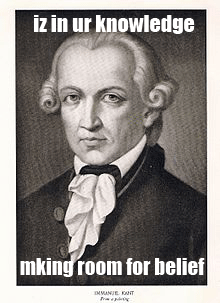
L is for LOLKants!


Okay, I may have temporarily missed out K, but that's only because I did so much drawing yesterday. Here are some LOLKants one day early, or late, or maybe on time, I've sort of forgotten where I was. 

But that's always what I do with advent calendars too....K tomorrow anyway (or later today if we're being technical)

bye!
becca x

Tuesday, 11 December 2012

Monday, 10 December 2012

Egad!

Don't worry fans! My computer is currently experiencing TECHNICAL problems but the advent calendar will be up and running ASAP! (Like when you forget to open it for a few days and then get to do 4 at once!) Yay! Bx

Friday, 7 December 2012

Day 7 (just!): G is for Game-Theory!

Somedays the commitment to drawing one picture a day fits right in with your schedule. Other days, it doesn't. Today is the latter, which is why a/the cartoon is a bit rough around the edges, and b/I am just gonna leave you with some wikipedia links to investigate on the subject of Game Theory.


And for the particular scenario that Being is talking about try here http://en.wikipedia.org/wiki/Prisoner's_dilemma

I'd be interested to hear people's comments on Game Theory, as I never feel like I got to the point of it as it were. It certainly wouldn't make a good board game...

bye!